Affichage des articles dont le libellé est Plantes. Afficher tous les articles
Affichage des articles dont le libellé est Plantes. Afficher tous les articles

Fossile de feuilles (Miguasha)


L’étude des plantes fossiles, ou paléobotanique, est une science en soi et l’évolution des plantes est passionnante!
Bien que le site de Miguasha soit surtout renommé pour ses poissons fossiles, plusieurs espèces de plantes sont aussi préservées dans la falaise. Elles étaient des éléments importants du paléoenvironnement dans lequel les poissons vivaient.
Au cours de l’histoire de la Vie sur Terre, les plantes ont précédé les invertébrés et les vertébrés sur la terre ferme et ont favorisé la formation des sols organiques propices à la vie et la mise en place d’une atmosphère plus hospitalière pour ces derniers, grâce à la production d’oxygène. Les plantes sont aussi une source de nourriture pour de multiples animaux.
À la fin du Dévonien, des arbres du genre Archaeopteris étaient présents partout sur la Terre et deux espèces sont documentées à Miguasha (380 millions d’années). Il y a encore beaucoup de travail de recherche à faire au sujet des plantes de Miguasha, il y a d’autres espèces de ce genre en collection qui sont encore à décrire.
Nous vous présentons ici deux spécimens de plantes fossiles :
1) une tige et des feuilles de l’Archaeopteris obtusa provenant de Miguasha (380 millions d’années)
2) Une feuille d’arbre de la période géologique du Trias (252 à 201 millions d'années) qui provient d’un autre site fossilifère (don). Cela ressemble beaucoup plus à une feuille d’arbres actuels. Tout comme les vertébrés, les plantes ont évolué!
Dans les deux cas, les détails préservés sur les feuilles sont impressionnants!
There's more than one way to build a tree, 374m-year-old fossils reveal

In the world of knee-high land plants 400m years ago, the battle to grow tall was won by plants which found biomechanical solutions to fight gravity. Vascular plants had already evolved a plumbing system, allowing them to transport water, and the food produced by photosynthesis, around the plant. The water-conducting cells in the xylem – dead, hollow and stiffened by the polymer lignin – also afforded them some structural support. But there are limits to the height that a plant can grow with a stem of fixed girth.
In modern trees, trunks grow outwards as well as upwards. Known as secondary thickening, a ring of dividing cells beneath the bark, called the vascular cambium, produces new xylem and phloem tissue. This is what wood is: secondary xylem, composed of dead lignified cells, now employed by trees as a building material to allow them to continue to grow tall.
Plants producing wood locked up carbon extracted from the atmosphere during photosynthesis and, when trees died, resulted in its burial in sediments. This storage over geological time as coal (which humans are so keen to dig up, burn and release the carbon from) changed how carbon cycled through our ecosystems. The first forests transformed our planet in other, less obvious, ways too. Tree root systems stabilised soil, changing the landscape and affecting how minerals in the sediments weather. These changes in weathering take carbon dioxide from the atmosphere, producing carbonic acid, which ends up in river systems, and ultimately puts the carbon in the ocean. The Earth’s carbon cycle, climate and the evolution of forests are inextricably linked.
How did the first trees solve their engineering challenge? Some of them used the same strategy as modern trees. Archaeopteris (not to be confused with the much more famous Jurassic bird Archaeopteryx) was one of the earliest trees, appearing in the Late Devonian, around 380 millon years ago, and found world-wide. Up to 20 metres tall, and with a trunk up to 1.5 metres in diameter, Archaeopteris has typical secondary thickening produced by a vascular cambium ring. It had seasonal growth rings like a modern temperate tree, and had flattened photosynthesising branches which could almost be described as leaves. Archaeopteris is one of several types of plant grouped together as progymnosperms: plants which had seed plant characteristics like wood production, but which still reproduced with spores.
Another group of early trees solved the structural problem of being a tree very differently. The gloriously-named cladoxylopsids first appeared around 390 Ma, and have been well-studied from sites in Germany, Scotland and USA. The fossil forest at Gilboa quarry in New York state, where tree stumps known as Eospermatopteris, preserved as sandstone casts, up to one metre in diameter, in life position, has been studied since the 1870s. These trees were reconstructed in 2007 as Wattieza, after a fossil tree complete with a palm-like crown of leafy fronds was discovered nearby.
New discoveries in China from Hong-He Xu and colleagues, from Nanjing Institute of Geology and Palaeontology, Cardiff University and Binghamton University, have revealed the strange anatomy of the trunk of cladoxylopsid trees. Where the Gilboa Wattieza trees are preserved as sandstone casts with little detail, the new fossils dating from 374Ma, from Xinjiang, China, are silicified, preserving the cellular details of their wood. They show that rather than a simple ring producing secondary tissue, cladoxylopsids had many separate and distinct xylem strands around the outside of the trunk, each one producing its own thickening rings, almost like a mini tree. An intricate network of interconnecting xylem tissue joined up the strands throughout the trunk, which was otherwise hollow.
It is the “ordinary” cortical tissue between the xylem strands which appears to have driven girth increase in these trees, by having such a high rate of cell proliferation that it pushed the ever thicker mini-trees apart, ripping the connecting xylem tissues in the process. The tree was in a state of continual, controlled internal collapse, repairing its internal tears as it grew. This seems like an incredibly over-complicated way to be a tree. Some modern palm trees do increase their girth by primary growth but in a much less complex way. Perhaps the cost of this elaborate anatomy was a factor in the demise of the cladoxylopsids, which disappear from the fossil record soon after these Chinese finds. These findings are yet another demonstration how much we still do not know about the diversity of plants and their anatomy through deep time.
Mont Saint-Hilaire
Le mont Saint-Hilaire a environ 125 millions d'années. Il s'est formé au Crétacé, lorsqu'une colonne de magma s'est infiltrée dans la croûte terrestre, refroidissant et durcissant progressivement. Ce processus s'est achevé il y a entre 133 et 120 millions d'années. Pendant des millions d'années, l'érosion a usé les roches environnantes plus tendres, laissant subsister la roche ignée plus dure et plus résistante de la montagne.
Il y a environ 125 millions d'années, l'est de l'Amérique du Nord était habité par divers dinosaures, bien que sa faune spécifique fût moins diversifiée que celle de la partie occidentale du continent à cette époque. Parmi les groupes clés, on trouve les premiers hadrosaures comme Protohadros, Claosaurus et Lophorhothon, le théropode Eubrontes et le sauropode à long cou Astrodon johnstoni.
Astrodon johnstoni : Sauropode herbivore à long cou qui vivait dans un environnement tropical de l'actuel Maryland. Eubrontes : Considéré comme le premier grand théropode (un type de dinosaure carnivore) découvert sur la côte Est.
Protohadros, Claosaurus et Lophorhothon : Premiers parents des hadrosaures, ou dinosaures à bec de canard.
Hypsibema : Autre dinosaure hadrosauroïde des Appalaches, comme Hypsibema crassicauda et Hypsibema missouriensis.
Hadrosaurus : et Eotrachodon : Exemples de la famille des Hadrosauridae découverts en Appalachie.
Pekinosaurus olseni : Dinosaure ornithischien primitif, ou herbivore, de Nouvelle-Angleterre.
Neovenator : Grand théropode. Bien que ses fossiles aient été découverts en Europe, ses dents sont similaires à celles de l'Allosaurus, plus grand, qui vivait plus tôt au Jurassique supérieur.
Il y a 125 millions d'années, l'écosystème de l'est de l'Amérique du Nord était chaud, humide et dominé par les cycadales, les fougères et les conifères. Les dinosaures parcouraient les terres et une vie marine diversifiée occupait les eaux peu profondes des mers intérieures. C'était le Crétacé inférieur, caractérisé par un niveau marin élevé, un climat plus chaud sans glace polaire et l'apparition précoce de plantes à fleurs qui allaient se diversifier au fil du temps.
Le climat était plus chaud et plus équitable qu'aujourd'hui, sans calottes glaciaires polaires. Les forêts étaient composées de plantes non fleuries comme les cycadales, les ginkgos, les conifères et les fougères.
Les premières plantes à fleurs (angiospermes) sont apparues et ont commencé à se diversifier à cette époque, bien qu'elles ne constituaient pas encore le groupe végétal dominant. Le plus ancien fossile d'angiosperme connu, Montsechia vidalii, date d'environ 125 millions d'années.
Extinction of Non-Avian Dinosaurs Led to Wide Scale Changes in Landscapes: Study

New research suggests dinosaurs were ecosystem engineers that promoted habitat openness in the Late Cretaceous epoch, and their extinction around 66 million years ago likely led to a dramatic reorganization of ecosystem structure: once dinosaurs were extinguished, forests were allowed to flourish; this had a strong impact on rivers: the newly dense forests stabilized sediments and corralled water into rivers with broad meanders.
“Very often when we’re thinking about how life has changed through time and how environments change through time, it’s usually that the climate changes and, therefore, it has a specific effect on life, or this mountain has grown and, therefore, it has a specific effect on life,” said University of Michigan paleontologist Luke Weaver.
“It’s rarely thought that life itself could actually alter the climate and the landscape. The arrow doesn’t just go in one direction.”
Dinosaurs became extinct after a large asteroid slammed into the Yucatan Peninsula around 66 million years ago.
Scientists looking for evidence of the asteroid saw that the rocks overlying the fallout debris were starkly different from the rocks below.
Dr. Weaver and colleagues began investigating this sudden geologic change in the Williston Basin, an area that spans eastern Montana and western North and South Dakota, as well as north-central Wyoming’s Bighorn Basin.
“While investigating a previous paper, we examined a rock layer called the Fort Union Formation,” Dr. Weaver said.
“The Fort Union Formation was deposited after the extinction of dinosaurs, and looks like it’s composed of stacks of different colored rocks — ‘pajama-striped looking beds’.”
“The brightly colored rock layers were thought to be pond deposits caused, some researchers thought, by a time of rising sea levels.”
“The rock formation was a stark contrast to the formations lying beneath it, which had waterlogged, poorly developed soils reminiscent of what you might see in the outer edges of a floodplain.”
The researchers began to suspect the change in geology was somehow related to the mass extinction of dinosaurs, called the end-Cretaceous mass extinction.
Moreover, they began to examine what types of environments were represented by these different rock formations.
“What we realized was that the pajama stripes actually weren’t pond deposits at all,” Dr. Weaver said.
“They’re point bar deposits, or deposits that form the inside of a big meander in a river.”
“So instead of looking at a stillwater, quiet setting, what we’re actually looking at is a very active inside of a meander.”
The large river deposits were bracketed by layers largely composed of lignite, a low-grade form of coal formed by carbonized plant matter.
The scientists believed these formed because with the stabilizing effect of dense forests, rivers flooded less frequently.
“By stabilizing rivers, you cut off the supply of clay, silt and sand to the far reaches of the floodplain, so you’re mostly accumulating organic debris,” Dr. Weaver said.
The evidence that would clinch whether the change occurred right after the end-Cretaceous mass extinction?
A fine layer of sediment loaded with iridium, an element typically only delivered to Earth by cosmic rays.
However, when the asteroid slammed into Earth, it carried with it a payload of the element, which settled over much of the planet in a fine layer.
This iridium-rich layer of sediment, which defines the Cretaceous-Paleogene boundary, carries about three orders of magnitude more iridium than typical sediments, and is called the iridium anomaly.
The authors then focused on an area the Bighorn Basin where the boundary hadn’t been located.
Looking at places of geologic change between the dinosaur-bearing formation and Paleocene-mammal-bearing formations, they took samples of a fine line of red clay about a centimeter in width.
“The iridium anomaly was right at the contact between those two formations, right where the geology changes,” Dr. Weaver said.
“That discovery convinced us that this isn’t just a phenomenon in the Williston Basin. It’s probably true everywhere throughout the Western Interior of North America.”
Still, the mystery of why the geology of landscapes should have changed so much before and after dinosaurs’ extinction remained.
But then the team encountered a series of talks about how present-day animals such as elephants influence the ecosystem in which they live.
“That was the light bulb moment when all of this came together,” Dr. Weaver said.
“Dinosaurs are huge. They must have had some sort of impact on this vegetation.”
The paleontologists suggested the sudden disappearance of dinosaurs allowed forests to flourish, helping to trap sediment, build point bars and structure rivers.
“To me, the most exciting part of our work is evidence that dinosaurs may have had a direct impact on their ecosystems,” said Dr. Courtney Sprain, a researcher at the University of Florida.
“Specifically, the impact of their extinction may not just be observable by the disappearance of their fossils in the rock record, but also by changes in the sediments themselves.”
The findings were published this week in the journal Communications Earth & Environment.


Le pin de Wollemi

The Wollemi pine, also known as the "dinosaur tree," was rediscovered in Australia in the 1990s after being thought extinct for millions of years.
This ancient conifer, a living fossil, is one of the world's oldest trees, with only 46 adults and 43 juveniles remaining in the wild.
Facing threats from wildfires and climate change, conservationists have bred genetically diverse Wollemi pines to ensure their survival. The first bred Wollemi pines have been distributed to botanical gardens worldwide, and one in England recently bore fruit, offering hope for the next generation.




Quand il y avait des palmiers au Québec...

A new study by Connecticut College provides strong evidence that palm trees once thrived in subarctic Canada, reshaping scientific understanding of past Arctic climates.
Professor Peter Siver's research, published in the journal Annals of Botany, confirms that during the late early Eocene—approximately 48 million years ago—this region maintained warm temperatures year-round, even during months of winter darkness. The work was done in collaboration with colleagues from Canada and Poland.
Siver's team identified fossilized phytoliths—microscopic silica structures formed in plant tissues—from palm trees in ancient lakebed sediments extracted from the Giraffe kimberlite pipe locality in Canada's Northwest Territories. These fossils, alongside preserved remains of warm-water aquatic organisms, indicate a climate far warmer than previously thought, challenging assumptions about when and where ice first formed in the Northern Hemisphere.
"The discovery of palm fossils this far north provides clear evidence that the Arctic was once ice-free, with a climate similar to today's subtropics," said Siver. "These findings give us a window into past greenhouse conditions and help refine models predicting future climate change."
Some of the fossil analysis for this study took place in Siver's lab at Connecticut College, where students are involved in examining microfossils to reconstruct ancient ecosystems. His ongoing research continues to provide hands-on opportunities for students to contribute to climate science while gaining experience with advanced microscopy and fossil identification techniques.
In addition to confirming the northernmost record of palms during this time, the study also documents, for the first time, fossilized stegmata—linear arrays of phytoliths in palm foliage—establishing that this evolutionary trait had emerged by the early Eocene. The presence of multiple warm-adapted aquatic species further reinforces that this prehistoric Arctic region supported a lush, temperate ecosystem.
Siver's research contributes to the broader understanding of Earth's climate history, particularly the extent and timing of ice formation in the Cenozoic era. By reconstructing these past environments, scientists gain valuable insights into how ecosystems respond to long-term climate shifts.
Comment la fin des dinosaures a directement conduit à l'émergence de la vigne

Il y a 66 millions d’années, volcanisme et astéroïde entraînaient la disparition des dinosaures. Au même moment apparaissaient les premières espèces de Vitacées, ancêtres de la vigne actuelle. Une étude révèle qu’il ne s’agirait pas là d’un hasard de l’évolution, mais qu’il y aurait bien un lien entre cette extinction de masse et l’apparition de ces plantes.
(...) Une nouvelle étude publiée dans Nature plants révèle en effet que la crise biologique ayant entraîné la disparition des dinosaures il y a 66 millions d'années aurait facilité le développement de certaines plantes, et notamment la vigne. Cette hypothèse résulte de la découverte, dans les Andes colombiennes, de la seconde plus ancienne espèce de Vitacée au monde.
Les Vitacées représentent une famille de plantes, souvent des lianes, à laquelle appartiennent les vignes domestiques (Vitis vinifera). L'analyse des grains fossilisés a montré qu'ils dataient de 60 millions d'années, soit peu de temps après l’extinction des dinosaures. Les plus anciens fossiles de cette famille de plantes ont quant à eux été retrouvés en Inde, et datent justement de 66 millions d'années. Coïncidence ? Ou la catastrophe environnementale marquant la fin du Crétacé aurait-elle joué un rôle dans l'essor de ces plantes ?
(...) Les plantes, elles aussi, ont été affectées par cette évolution de l'environnement. De nombreuses espèces ont disparu, libérant ainsi certaines niches écologiques. Mais la disparition des dinosaures pourrait tout de même avoir joué un rôle. Il est certain en effet que les dinosaures, du temps de leur présence, ont impacté les écosystèmes forestiers. Les grands herbivores, pouvant peser plusieurs dizaines de tonnes, auraient notamment permis de maintenir des forêts plutôt ouvertes. À la suite de leur extinction, ces forêts tropicales seraient devenues plus denses et compactes, entraînant le développement de plantes grimpantes et de lianes, comme les Vitacées.
En parallèle, le développement accéléré des oiseaux et des mammifères aurait favorisé leur extension géographique, ces animaux se nourrissant des fruits et permettant une vaste et rapide dispersion des graines.
Rare 3D fossil discovery sheds light on unusual shapes of early trees

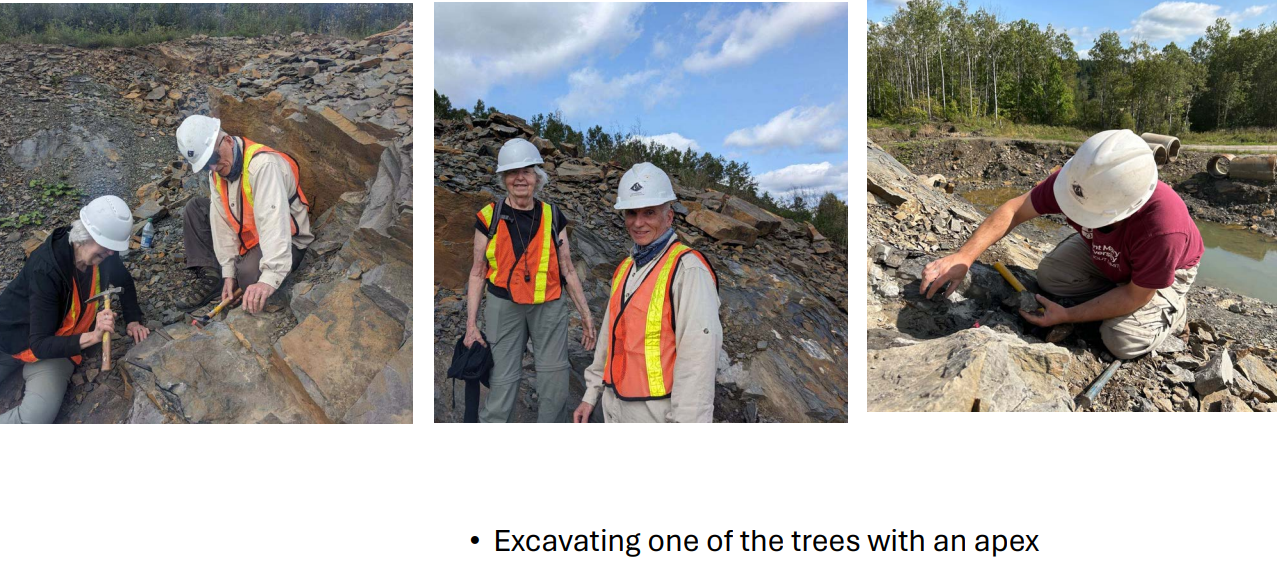
Newly discovered tree fossils from New Brunswick, Canada, are rewriting the story of ancient trees, revealing features never before seen.
The fossils, which include an unexpected three-dimensional crown structure, provide a unique glimpse into the morphology of trees dating back 350 million years. This fossilized tree species has been scientifically named Sanfordiacaulis densifolia.
“The way in which this tree produced hugely long leaves around its spindly trunk, and the sheer number over a short length of trunk, is startling,” said Robert Gastaldo of Colby College in Waterville, Maine.
This fossil finding is important, especially given that most trees are only preserved as trunks, with no indication of canopies or overall forms.
According to the press release, the preservation of this fossil occurred due to its burial in an ancient rift lake induced by an earthquake.
The ancient tree looked like ferns
The recently discovered ancient tree resembles ferns or palms, which makes it a surprising discovery as palms appeared much later in the known record.
However, unlike ferns and palm trees, which have fewer leaves at the top, the fossilized tree has over 250 leaves along its stem.
“In contrast, Sanfordiacaulis preserves more than 250 leaves around its trunk, with each partially preserved leaf extending 1.75 meters from it,” Gastaldo said.
Gastaldo added, “We estimate that each leaf grew at least another meter before terminating. This means that the ‘bottle brush’ had a dense canopy of leaves that extended at least 5.5 meters (or 18 feet) around a trunk that was non-woody and only 16 centimeters (or 0.5 feet) in diameter. Startling, to say the least.”
The researchers posit that Sanfordiacaulis represents the earliest documented evidence of smaller trees thriving beneath a taller forest canopy. Moreover, it provides remarkable evidence of diverse plant life in the Early Carboniferous epoch.
“We all have a mental concept of what a tree looks like, depending on where we live on the planet, and we have a vision of what is familiar,” Gastaldo said.
“The fossil on which we report is unique and a strange growth form in the history of life. It is one of evolution’s experiments during a time when forest plants underwent biodiversification, and it is a form that seems to be short-lived,” Gastaldo concluded in the press release.
The findings were published in the journal Current Biology.
Study abstract:
The evolution of arborescence in Devonian plants, followed by their architectural radiation in the Carboniferous, is a transition fundamental to Earth-system processes and ecological development. However, this evolutionary transition in trees is based on preserved trunks, of which only a few known specimens possess crowns. We describe Mississippian-aged (Tournaisian) trees with a unique three-dimensional crown morphology from New Brunswick, Canada. The trees were preserved by earthquake-induced, catastrophic burial of lake-margin vegetation. The tree architecture consists of an unbranched, 16-cm-diameter trunk with compound leaves arranged in spirals of ~13 and compressed into ~14 cm of vertical trunk length. Compound leaves in the upper ~0.75 m of the trunk measure >1.75 m in length and preserve alternately arranged secondary laterals beginning at 0.5 m from the trunk; below the trunk bears only persistent leaf bases.
La plus ancienne forêt de la Terre a près de 400 millions d’années

La découverte récente de fossiles d’arbres dans le sud-ouest de l’Angleterre a révélé l’existence de ce qui est maintenant considéré comme la plus ancienne forêt connue sur Terre. Ces fossiles, datant de 390 millions d’années, dépassent en ancienneté ceux de la forêt fossile de Gilboa, dans l’État de New York, qui datait de 386 millions d’années. Cette trouvaille, qui remet en question notre compréhension des écosystèmes forestiers primitifs, marque un jalon important dans l’étude de l’évolution des forêts sur notre planète.
Des arbres préhistoriques transformateurs
L’évolution des arbres et des forêts durant la période du Dévonien a joué un rôle crucial dans la transformation de notre planète. En stabilisant le sol et en interagissant avec l’atmosphère ainsi que les cycles de l’eau, les arbres ont en effet profondément modifié les environnements terrestres.
À partir du milieu de l’ère du Givétien (environ 387 à 382 millions d’années avant aujourd’hui), un groupe d’arbres appelés lignophytes (les ancêtres des arbres modernes qui possèdent du bois) est devenu particulièrement influent dans les processus naturels. Cependant, l’impact des forêts plus anciennes, composées principalement de cladoxylopsidés (des arbres préhistoriques qui n’étaient pas aussi boisés que les lignophytes), est moins connu et compris, d’où l’intérêt de cette nouvelle découverte.
La plus ancienne « forêt fossile » connue
Dans le cadre d’une nouvelle étude, une équipe de scientifiques révèle l’existence d’une ancienne forêt de cladoxylopsidés vieille de 390 millions d’années dans la formation de grès Eifelian de Hangman, située dans les régions du Somerset et du Devon, au sud-ouest de l’Angleterre. Auparavant, cette zone était pourtant considérée comme ayant peu d’intérêt paléobotanique, c’est-à-dire en termes de fossiles de plantes.
Or, en plus de nous dévoiler les premiers fossiles de ce type d’arbres dans les archives britanniques, ces recherches mettent également en lumière la plus ancienne preuve à ce jour de la disposition spatiale des arbres, ce qui, en termes simples, constitue la plus ancienne « forêt fossile » connue.
Un couvert forestier très différent d’aujourd’hui
Cette ancienne forêt ne semble avoir abrité qu’une seule espèce de plante. Ces végétaux avaient une apparence similaire à celle des palmiers, avec une longue tige centrale et des branches qui ressemblent à des feuilles de palmier, bien qu’elles ne soient en réalité qu’un agglomérat de petites branches. Ces arbres, qui mesuraient entre deux et quatre mètres de haut, composaient une forêt relativement basse par rapport aux standards actuels.
Les méthodes de préservation de ces arbres fossiles sont remarquables : certains ont été conservés sous forme de troncs creux remplis de sédiments, tandis que d’autres, des bûches tombées, ont été compressées au fil des millénaires, formant des moulages au sein des sédiments. Ces fossiles, qui portent encore les marques des branches, offrent ainsi un aperçu unique de la structure et la composition de ces arbres anciens.
Notez qu’à cette époque, l’actuel Royaume-Uni se trouvait sur le continent de Laurentia, près de l’équateur, et bénéficiait donc d’un climat chaud et sec.
En outre, cette forêt ne représente pas seulement les premiers arbres à avoir poussé en masse et de manière rapprochée, mais elle témoigne également d’un écosystème où les premiers arthropodes terrestres commençaient à émerger. Les chercheurs ont en effet trouvé des traces de ces petites créatures dans les sédiments entourant les arbres fossiles, ce qui indique une biodiversité naissante.
Cette découverte aura des implications majeures pour notre compréhension de l’évolution des écosystèmes forestiers sur Terre. Elle suggère en effet que les environnements forestiers connaissaient déjà une expansion rapide à cette époque, marquant un tournant décisif dans l’histoire de la végétation terrestre.
Les détails de l’étude sont publiés dans le Journal of the Geological Society.
Plus ancienne forêt pétrifiée


Scientists have discovered the world's oldest petrified forest.
Destruction massive

On savait déjà qu'un cataclysme majeur survenu à la fin du Permien (il y a environ 250 millions d'années) avait causé des extinctions massives: 95% des espèces marines et 70% des animaux terrestres furent complètement anéantis.
Une récente étude semble indiquer que les forêts elles-mêmes furent détruites:
Massive volcanic eruptions wiped out the world's forests about 250 million years ago, leaving the planet teeming with wood-eating fungi, according to a new study. The finding confirms that even hardy trees didn't survive the Permian mass extinction, one of the most devastating losses of life Earth has ever known. (...) But the new study confirms that vegetation also suffered heavy casualties. (...) And trees remained a rarity for the next four million years. But fungi, which could cope with the newly acidic world, survived.
L'étude est accompagnée d'un avertissement pour l'avenir:
On a global scale, human activity is altering the balance of gases in Earth's atmosphere "faster than anything we see in the geological record," Sephton added. In addition, the drop in species diversity today mirrors the early stages of the Permian event. "This is mankind's great unnatural experiment," Sephton said, "and we just don't know how it is going to end."
Photo trouvée ici.
Lycophytes

Les Lycophytes forment le groupe le plus primitif des plantes vasculaires actuelles. Ce sont des végétaux à ramifications dichotomique, avec notamment un rhizome ou rhizophore basal dichotomiquement divisé. Leurs feuilles sont sessiles. Il s'agit de végétaux homosporés ou hétérosporés.
L'étude des genres fossiles primitifs démontre que les coiffes de leurs racines sont apparues plus tardivement que chez les autres plantes vasculaires (Euphyllophyta) et a permis d'établir que les racines des lycophytes sont une évolution convergente à celle des autres Trachéophytes. Les racines sont donc apparues deux fois dans l'évolution des plantes vasculaires3,4.
Composées de grands arbres durant l'ère Primaire (notamment les genres Sigillaria et Lepidodendron), les Lycophytes ne comprennent plus aujourd'hui que des plantes herbacées. On en compte un millier d'espèces actuelles environ.
Le frère Marie-Victorin, éminent botaniste, écrivait en 1925 que la famille des lycophytes (autrefois appelés lycopodes) regroupait des plantes « infiniment attrayantes par l’élégance de leurs formes ». Vous découvrirez que cette observation est toujours valable de nos jours pour chacune des sept espèces de lycophytes observées sur le territoire du massif des falaises.
Ces plantes aux allures de petits conifères restent petites toute leur vie et ne produisent ni fleurs, ni graines, mais se reproduisent plutôt grâce à des spores. Leur lien de parenté est plutôt du côté des fougères et des prêles. Ce ne sont pas non plus des mousses puisque, contrairement à ces dernières, les lycophytes possèdent des racines et des tissus pour faire circuler leur sève.
L’apparition des lycophytes remonte à environ 350 millions d’années. À cette époque, ils abondaient et ils étaient représentés alors par deux lignées: les individus de la première lignée pouvaient mesurer jusqu’à 40 mètres de haut et deux mètres de diamètre. Ils ont prospéré dans un climat chaud et humide pendant des millions d’années. Mais lorsque le climat s’est refroidi et asséché, seuls les représentants de la deuxième lignée, constituée de petites plantes herbacées, ont survécu. On compte aujourd’hui environ 1200 espèces de lycophytes dans le monde, dont une quinzaine au Québec.
Les lycophytes sont toujours présents, ajoutant leur touche de vert au paysage à moins d’être ensevelis sous une neige épaisse. Ils sont autant de « vestiges d’un passé disparu » qui contribuent à la beauté de nos collines laurentiennes. Nous vous proposons de faire connaissance avec eux!

La flore de Miguasha est dominée par un nombre très limité d’au plus cinq espèces. Les flores fossiles trouvées dans d’autres localités du Dévonien supérieur ont livré des assemblages plus diversifiés. Comparée par exemple aux flores du début du Frasnien de l’État de New York, il manque à la Formation d’Escuminac des groupes typiques comme les progymnospermes de type aneurophytales, des cladoxyles, des iridopterides, des lycophytes...

Inscription à :
Articles (Atom)